 Book now
Masaccio's Tribute Money: how to read the fresco in the Brancacci Chapel
One Gospel story told three times in one landscape, built around a single vanishing point at Christ's head.
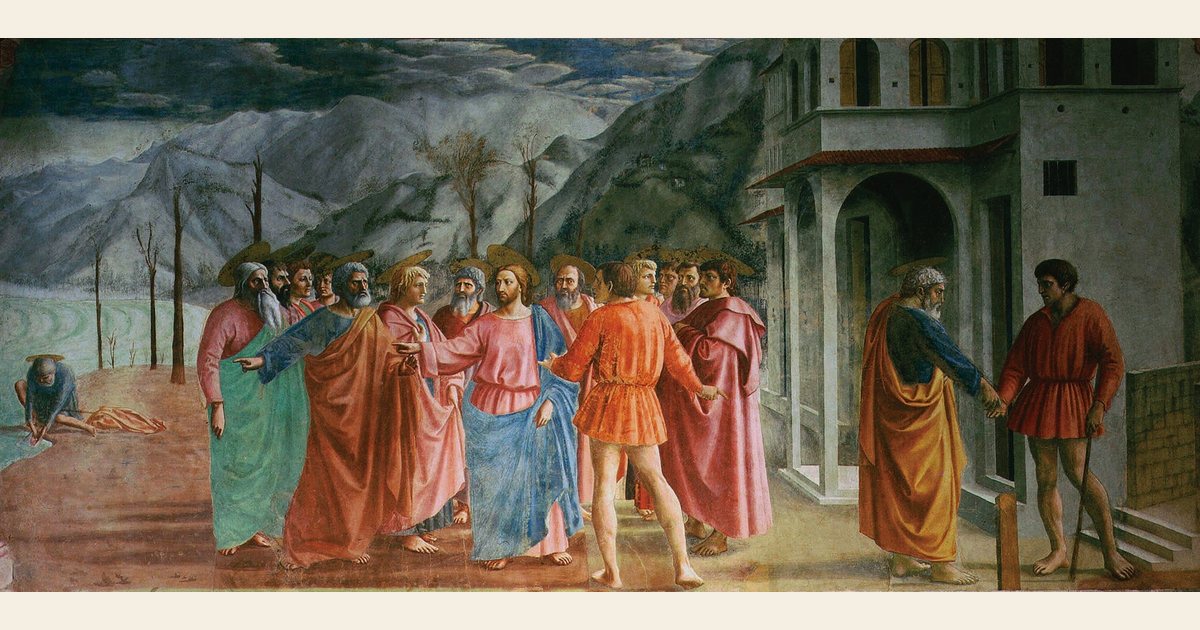
The Tribute Money is the largest and most famous scene in the Brancacci Chapel, and one of the founding pictures of Renaissance painting. It is about 2.5 metres high and almost 6 metres wide, on the upper register of the left wall, and Masaccio painted it around 1425, in his early twenties. At first it can look like a crowd of solemn men in coloured cloaks. Once you know how it is put together it becomes a story you can follow in seconds, and a demonstration of almost everything that was new about Masaccio: figures with weight, light with a direction, space built to a single point, and a landscape that fades into the distance. This guide walks through the picture the way you will see it from the chapel floor.
The story
The subject comes from the Gospel of Matthew, chapter 17. When Christ and his disciples arrive at Capernaum, collectors ask whether their master pays the tax. Christ tells Peter to go to the water and cast a line: in the mouth of the first fish he catches he will find a coin, enough to pay for both of them. Peter does so, and pays.
It is an unusual subject for a cycle of the life of St Peter, and historians have long linked it to Florence in the 1420s. The city was debating the Catasto, a new tax on wealth introduced in 1427, which fell most heavily on rich merchant families. A picture in which Christ himself accepts that a tax is owed reads well as a civic argument, painted for a merchant patron.
Three moments in one landscape
Masaccio tells the story three times without dividing the picture into panels. The central group shows the first moment. A tax collector, seen from behind in a short orange tunic and bare legs, faces Christ and holds out his hand. Christ, at the centre of the twelve, answers him and points to the left with one hand; Peter, beside him, makes the same gesture, as if repeating the instruction with some reluctance.
Follow the gesture to the far left. In the middle distance, on the shore of the lake, Peter crouches with his cloak laid on the ground and takes the coin from the fish's mouth. It is small and easy to miss, which is part of the pleasure of finding it.
Now look right. Under the arch of a building that stands for the city gate, Peter, in his yellow cloak over blue, presses the coin into the collector's hand. The collector appears twice, once in each scene, in the same tunic. The three episodes read left, centre, right, but the eye starts in the middle, where the drama is, and is sent outward by the gestures.
A ring of apostles
The apostles stand around Christ in a loose circle, close together, their heads more or less on one level. It is a way of composing a crowd that goes back to Giotto, whose frescoes Masaccio would have studied in Florence, and it gives the group the solidity of architecture. Each figure stands on the ground, feet planted, and each has a face of its own: old and bearded, young and clean-shaven, puzzled, stern.
The heavy cloaks hang like real cloth on real bodies. Masaccio models them with light and shade rather than outlines, and you feel the weight of the wool. This was what later painters came to the chapel to study. Among them was the young Michelangelo, whose pen drawing of the figure of Peter from this fresco survives in Munich.
The apostle on the far right of the group, in a wine-coloured cloak, has a sharper, more individual face than the others. Some have suggested he is a self-portrait of Masaccio; others a portrait of Felice Brancacci. Nobody knows.
Notice, too, how little anyone moves. Apart from the pointing hands, the figures are almost still. Masaccio gets his drama from weight, gaze and gesture rather than from action, and that restraint is part of why the scene feels so grave.
Perspective: all lines lead to Christ
The building on the right is drawn in single-point perspective. If you extend its receding lines, they meet at a single point on the horizon, and that point is Christ's head. The geometry of the picture and its meaning coincide: the vanishing point is the centre of the story.
Masaccio was one of the first painters to use a central vanishing point in this way. He was a friend of Brunelleschi, who had worked out the method, and of the sculptor Donatello. The Tribute Money is one of the clearest early demonstrations of what the method could do: give a painted wall a space you could walk into.
The perspective is built for someone standing in the chapel, looking up. You are that person. From the middle of the floor the figures sit on a ground that seems continuous with the ledge below the fresco.
Light from the chapel's window
In the Tribute Money, as in the Expulsion beside it, the light falls from the right and the figures cast shadows to the left. The right is where the real light in the chapel comes from: the window on the end wall behind the altar. Masaccio painted the light as if it came from that window into the picture.
It is a small decision with large consequences. The figures stop being decorations on a wall and become bodies standing in the same light as you. Look at the shadows on the ground at the apostles' feet, and the way the right side of each cloak is lit and the left falls into shade.
The landscape and the sky
Behind the group, a lake shore runs back to a range of bare mountains under a cloudy sky. The mountains grow paler and bluer as they recede, which is how distance actually looks. Painters call this atmospheric or aerial perspective, and here it works together with the linear perspective of the building.
The trees are bare trunks. That is damage, not design. Fresco painters added some details, such as leaves, on the dry plaster afterwards, and those touches do not last as well as the colours bound into the wet plaster. The leaves have gone; so has much of the blue of Christ's robe, which was also partly applied dry.
Thirty-two days of plaster
Fresco is painted on wet lime plaster. As the plaster dries, the pigment is locked into it, so the painter can only lay down as much fresh plaster each morning as he can paint before it sets. Each of these patches is called a giornata, a day's work. The joins between them can often be traced across a fresco if you know where to look.
Studies of the Tribute Money count 32 giornate. Masolino's St Peter Preaching, behind the altar, took eight. The difference is partly size and partly ambition: faces and hands, which needed the most care, often have a giornata of their own.
Fire, grime and the restoration
The fresco has had a hard history. In 1746–48 the upper parts of the chapel were redecorated, and the vault and lunettes above were lost. In 1771 a fire destroyed the interior of the Carmine church. The chapel survived, but smoke and later cleaning left the paintings dark, so dark that Masaccio was long described as a painter of sombre, stony colour.
A full restoration in the 1980s, completed in 1990, removed the grime and later additions. It revealed the original colour: the oranges, pinks, greens and blues you see now. It also confirmed how much had been lost where paint had been applied dry. What remains is Masaccio's colour, not a modern repaint.
Who Masaccio was
Masaccio was born Tommaso di Ser Giovanni di Simone on 21 December 1401 in Castel San Giovanni, now San Giovanni Valdarno, in the hills south-east of Florence. His father, a notary, died when he was five. Nothing certain is known of his training, but on 7 January 1422 he joined the Florentine guild that included painters, as an independent master.
His nickname is a joke. Maso is short for Tommaso, and Masaccio means something like clumsy or messy Tom, perhaps to tell him apart from his older collaborator, also a Tommaso, who became Masolino, little Tom. Vasari later praised him above all for imitating nature: lifelike figures, convincing movement, a sense of real depth.
His working life lasted only about six years. He went to Rome in 1427 or 1428 and died there in the summer of 1428, aged 26. When Brunelleschi heard the news, he is reported to have said: "We have suffered a great loss." The Brancacci Chapel is the largest body of his work to survive, and the Tribute Money is its centre.
Masaccio and Masolino on the same walls
The best way to understand the Tribute Money is to compare it with Masolino's work in the same room. Turn to the opposite wall and look at his Healing of the Cripple and Raising of Tabitha, painted at the same time. The figures there are graceful and lightly modelled; the two young men in the middle stroll through the square as if in a pageant. Masolino builds a fine perspective street behind them, but the people feel weightless.
Then turn back to Masaccio. His apostles stand like a wall, the folds of their cloaks heavy, their shadows falling on the ground. The two painters worked together on the scaffolding and almost certainly helped each other, but on the walls their temperaments are unmistakable, and the comparison is half the pleasure of the chapel.
Seeing it on your visit
From the chapel floor the Tribute Money is above eye level, on the left as you face the altar. Stand a little back from the left wall, towards the right side of the chapel, to see it straight on. Find the tax collector's orange back first, then Christ, then follow the pointing hands left to the lake and right to the gate.
Then look below it, to the Raising of the Son of Theophilus, where Masaccio's work stops and Filippino Lippi's begins, and across at Masolino's Tabitha scene on the opposite wall. Seen together, the three tell you what Masaccio added to painting in a few years of work in this room.
Frequently asked
How big is the Tribute Money?
About 247 by 597 centimetres, the largest scene in the chapel.
When was it painted?
Around 1425, by Masaccio, as part of the Brancacci Chapel cycle.
What is the vanishing point?
Christ's head. The receding lines of the building on the right meet there.
Why does Peter appear three times?
The fresco tells three moments in one landscape: the demand at the centre, the coin from the fish at the left, the payment at the right.
Why are the trees bare?
The leaves were painted on dry plaster and have flaked away over time. So has much of the blue of Christ's robe.
Did Michelangelo copy it?
Yes. A pen drawing by the young Michelangelo after the figure of Peter in this fresco is in the graphic collection in Munich.